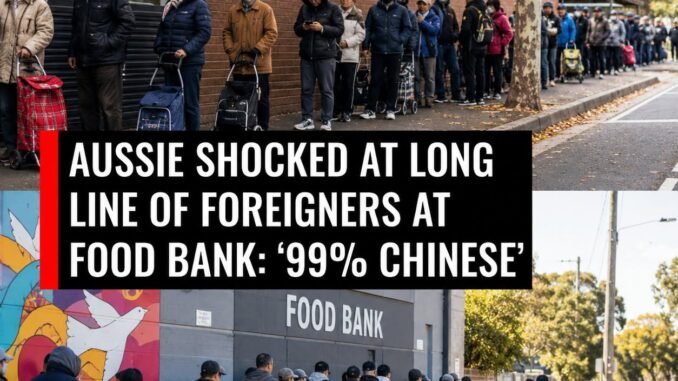
A video showing hundreds of people lining up outside a Melbourne food relief centre has triggered a heated debate about cost-of-living pressures, migration and the growing demand for charitable assistance.
The footage was captured outside a food relief distribution point in Southbank and quickly attracted attention online.
What caught people’s attention was not simply the length of the queue.
Geographic Reference
It was who appeared to be standing in it.
The man who filmed the scene claimed the overwhelming majority of those waiting were foreigners, many of whom appeared to be of Chinese background.
His comments rapidly spread across social media and generated strong reactions from Australians on both sides of the argument.

The footage was taken outside the Empower Australia Food Relief Centre in Southbank.
According to the organisation, it provides assistance to a wide range of vulnerable groups including elderly Australians, refugees, homeless people, single parents and international students. The service operates in partnership with major food relief providers and community organisations.
The man who recorded the video said he became frustrated after seeing what he described as a queue dominated by people who did not appear to be Australian-born.
He argued that extremely long waiting lines could discourage vulnerable locals from seeking assistance, particularly families with young children who may struggle to wait outdoors during winter.
His observations quickly became the focus of online discussion.
For many Australians, the issue extends beyond a single food bank.
The country is currently experiencing one of the most severe cost-of-living squeezes in decades.
Rising rents, mortgage repayments, energy bills and grocery prices have pushed increasing numbers of households toward financial hardship.
Food relief organisations have repeatedly reported growing demand as more people seek assistance.
Foodbank Australia estimates that millions of households have experienced food insecurity during the past year.
The organisation says demand for support has continued to rise as household budgets remain under pressure.
Many charities have struggled to keep pace with the growing number of people seeking help.
Supporters of the food relief programs argue that appearance alone does not reveal a person’s circumstances.
They point out that refugees, migrants and international students can face significant financial hardship, particularly when family support networks are limited.
Some community groups note that food assistance programs are generally designed around need rather than citizenship status.
International students have featured prominently in previous discussions about food relief.
During the pandemic, food charities reported large numbers of foreign students relying on emergency food support after losing employment and being excluded from many government assistance programs.
Some charities created dedicated initiatives specifically to address that need.
Critics, however, argue that growing demand from migrants and international students raises difficult questions about resource allocation.
They believe charitable assistance should prioritise struggling Australians if resources become limited.
Others argue the real issue is not who is receiving assistance, but why so many people need it in the first place.
They point to housing shortages, rising living costs and economic pressures that are affecting both Australian-born residents and newcomers alike.
That perspective shifts the focus away from ethnicity and toward broader structural challenges facing the country.
The debate has become particularly sensitive because it intersects with several issues already dominating political discussion.
Housing affordability, migration levels, international student numbers and cost-of-living pressures have all become major concerns for voters.
As a result, a single video can quickly evolve into a much larger national conversation.
Some Australians see the footage as evidence that public resources are being stretched too far.
Others see it as proof that economic hardship is affecting a much wider group of people than many realise.
Both interpretations have gained support online.
The reaction also highlights how visible food bank queues have become symbols of economic stress.
For years, food relief services were often associated with a relatively small group of people experiencing severe hardship.
Today, charities report increasingly diverse groups seeking assistance, including workers, students, retirees and families struggling with rising expenses.
Whether people view the Southbank footage as a migration story or a cost-of-living story often depends on their broader political perspective.
That is one reason the video has generated such intense engagement.
It touches multiple concerns simultaneously.
Immigration.
Housing.
Food insecurity.
Economic pressure.
And public resources.
What remains undisputed is that demand for food relief remains high.
Charities across Australia continue to report increasing numbers of people seeking help as living costs remain elevated.
As long as those pressures continue, debates over who needs assistance, who receives assistance and how support should be delivered are likely to remain part of Australia’s public conversation.
Leave a Reply