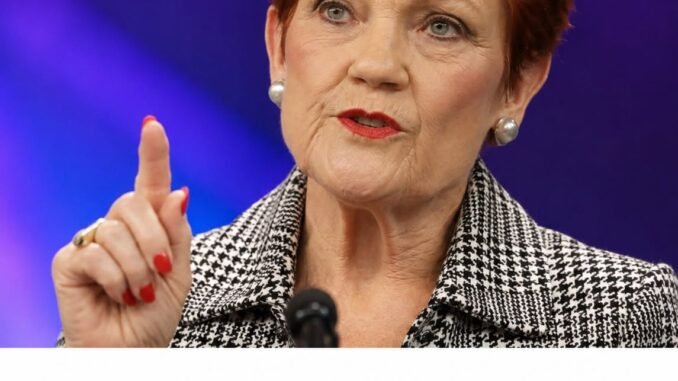
Pauline Hanson has launched one of the broadest policy offensives of her political career, using her first National Press Club address to challenge both Labor and the Coalition on everything from government spending and immigration to cultural issues and national identity.
The One Nation leader delivered a speech that ranged far beyond the housing and migration debates that have dominated recent headlines, outlining a vision that would significantly reshape the role of government and the direction of public policy in Australia.
By the end of the address, it was clear Hanson was attempting to position One Nation as more than simply a protest party.
Instead, she presented a platform designed to challenge major parties across multiple policy fronts simultaneously.

A central theme of the speech was government spending.
Hanson argued that Australians were carrying an increasing financial burden while governments continued expanding programs, departments and bureaucracies.
She said taxpayers deserved greater value for money and called for a review of spending priorities across multiple areas of government.
According to Hanson, Australia needs a leaner and more efficient public sector that focuses on essential services rather than ideological projects.
That message formed a key part of her economic argument.
She linked concerns about public spending directly to cost-of-living pressures, claiming many Australians feel government priorities have become disconnected from everyday realities.
The speech also focused heavily on immigration.
Hanson repeated her claim that Australia is facing an immigration crisis and argued that population growth has outpaced the nation’s ability to provide housing and infrastructure.
She said migration levels should be aligned more closely with available housing supply and public services.
Housing affordability remained one of the major themes throughout the address.
Hanson argued that many young Australians feel increasingly locked out of home ownership while governments continue pursuing policies that increase demand.
She claimed the issue has become one of the defining economic challenges facing the country.
Another major focus involved cultural and social policy.
Hanson criticised what she described as growing ideological influence within public institutions and argued that political leaders should pay greater attention to concerns being raised by ordinary voters.
She suggested many Australians feel uncomfortable expressing their views on sensitive issues for fear of criticism or social backlash.
Those comments drew significant attention because they touched on debates that have become increasingly prominent in politics across Australia and other Western democracies.
Supporters argue such discussions are necessary and overdue.
Critics contend they risk inflaming social divisions and distracting from more practical policy challenges.
The speech also included strong remarks regarding national security and social cohesion.
Hanson argued that governments should take a tougher approach toward extremism and ensure that immigration policies support successful integration into Australian society.
She said national identity and shared values should play a greater role in public policy discussions.
Those comments aligned with her broader call for a stronger sense of national unity.
Throughout the speech, Hanson repeatedly returned to the idea that Australia needs a clearer understanding of its national interests.
She argued that too many policy decisions are being driven by political fashion rather than long-term outcomes.
The National Press Club event attracted widespread attention because it represented Hanson’s first appearance at the prestigious forum despite her long political career.
The audience included journalists, political observers and representatives from across the political spectrum.
Questions following the speech were often robust and highlighted the controversial nature of many of her proposals.
Several exchanges generated significant discussion on social media and helped ensure the speech remained a major political talking point throughout the day.
For supporters, the address demonstrated that Hanson was willing to raise issues that other politicians avoid.
Many viewed the speech as an attempt to give voice to concerns about housing, immigration and government accountability.
For critics, however, the address represented a collection of divisive arguments designed to generate headlines rather than practical solutions.
They argued that complex challenges require more detailed policy responses than those presented during the speech.
Regardless of where Australians stand on the issues, the address succeeded in placing One Nation at the centre of national political discussion.
It also highlighted the party’s efforts to broaden its appeal beyond its traditional support base.
With cost-of-living pressures continuing to dominate public debate and frustration with major parties remaining high, Hanson appears determined to use that environment to expand One Nation’s political influence.
Whether voters embrace that vision remains to be seen, but the National Press Club speech has ensured that Hanson’s policy agenda will remain part of Australia’s political conversation for some time.
Leave a Reply