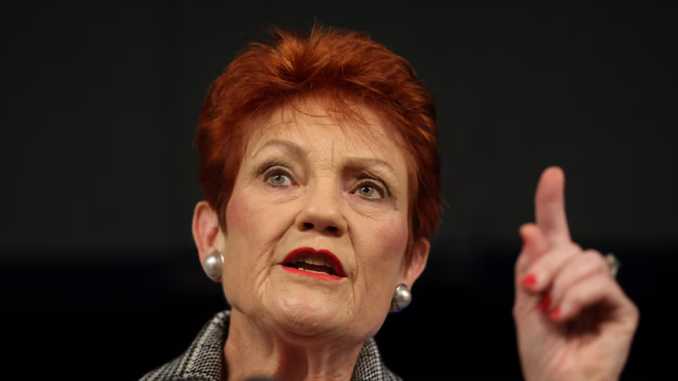
“We are being taken for bloody fools.”
If there’s one sentence that sums up Pauline Hanson’s attitude to Australia’s place in the world, this probably is it.
With One Nation running red hot in the polls and posing a serious challenge to the incumbent parties, there’s more and more scrutiny on what its policies would mean for Australia.
This month the right-wing populist political party led against both major political parties in an opinion poll by RedBridge Group and Accent Research.
Senator Hanson now has Barnaby Joyce as her “treasury spokesman” and the backing of billionaire Gina Rinehart, with whom she says she consults on policy.
In response, Labor has launched a fundraising campaign to fight Pauline Hanson’s political movement, while the opposition has left the door open to a preference deal with the party.
And that means it’s worth taking a look at how a government run, or heavily influenced, by One Nation would approach the world outside its borders.
So, what sort of foreign policy might it adopt?
What might it mean for Australia’s place in this region, and for our ties across Asia?
And what are the implications for our national security and strategic position if any government followed through with it?
Answering these questions isn’t always easy.
The party doesn’t have a detailed foreign policy platform on its website, and its political preoccupations have usually been domestic — not international.
When Pauline Hanson was asked to describe her foreign policy this week she kept her answer very brief and very generic, saying it was “important to have diplomatic relations with many countries around the world”.
But still, when you examine the record, there are some clear themes that emerge.
One Nation is a nationalist, isolationist and protectionist party, which means that in many ways it wants to withdraw from the world, rather than engage with it.
That means toppling many of the foundations that sit underneath Australian foreign policy today, and turning most of the assumptions that guide it on their head.
Putting Australia first and the UN last
One of the most obvious ways it would do this is through dumping decades of orthodoxy and fundamentally transforming the way Australia engages with international institutions — slashing foreign aid, radically cutting immigration, pulling out of the United Nations, and tearing up international agreements.
One Nation has repeatedly promised to withdraw (or at least review) Australia’s membership of a host of international agreements and organisations such as the United Nations, the World Health Organization, and the Paris Agreement.
The party argues that will not only save money — potentially around $1 billion — but it would protect Australian sovereignty by ditching binding international agreements.
In January last year, Senator Hanson celebrated the Trump administration’s move to pull the US out of the WHO, saying the UN had “hopelessly lost its way”.
“It’s become a platform for abhorrent regimes to claim legitimacy, a forum of hatred for western countries like Australia, and a tacit supporter of international terrorism,” she said at the time.
“It’s been said that countries don’t have friends; they have interests. The UNHCR, the UNRWA, the International Criminal Court — are we a member or a party to these unelected world organisations because it is truly in our nation’s interest?”
The argument for sovereignty resonates with many — Darren Lim from the Australian National University (ANU) says One Nation is channelling an “understandable sense of despair that in a globalising and technologically advancing world, many people feel they have lost control”.
“Populist parties tend to want to nullify the impacts of outside forces like globalisation, like the international system of rules and institutions, and claim that in doing so they are protecting sovereignty,” he told the ABC.
The problem, he says, is that withdrawing from international bodies will inevitably reduce, rather than grow, Australia’s power and agency.
“We will lose a voice at those institutions to shape their decision-making and direction, and we will also undermine our reputation as a responsible middle power with most of the world and all of the region,” he says.
“And the money saved in membership fees and contributions to these organisations will be a tiny fraction of the money needed to invest in other capabilities to have a hope of influencing other governments in our region.”
Shiro Armstrong from the ANU’s Crawford School of Public Policy goes further, warning it would be an “own goal of epic proportions” and “make Australia a rogue state in the international community”.
Leave a Reply