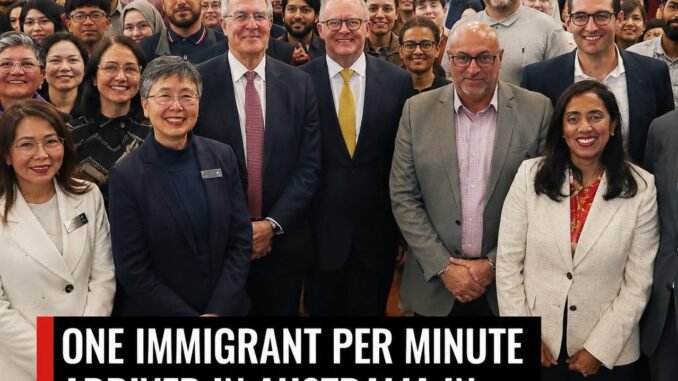
Australia’s migration debate has intensified after newly released figures showed more than 563,000 people arrived in the country during 2025, reigniting concerns about housing affordability, infrastructure pressures and population growth.
The numbers have quickly become a political flashpoint, with critics arguing that migration levels remain too high at a time when many Australians are already struggling with rising rents, housing shortages and increasing living costs.
Supporters of current migration settings, however, argue that Australia continues to rely on overseas arrivals to fill workforce shortages, support economic growth and meet the needs of critical industries.
The result is a debate that reaches far beyond immigration itself.

Housing sits at the centre of the discussion.
Across many parts of the country, rental vacancy rates remain low while property affordability continues to challenge both first-home buyers and renters.
Critics argue that rapid population growth increases demand faster than new housing can be delivered, placing additional pressure on an already constrained market.
For many Australians, the connection between migration and housing has become one of the most closely watched policy issues in the country.
Political opponents of the government have used the latest figures to question whether migration levels are aligned with Australia’s ability to provide sufficient housing and infrastructure.
Some have argued that planning systems, transport networks, schools and hospitals are struggling to keep pace with population growth.
Those concerns have become increasingly prominent as housing affordability remains one of the biggest issues facing households nationwide.
The Albanese government has consistently argued that migration serves an important economic purpose.
Business groups and industry organisations have frequently highlighted labour shortages across sectors including healthcare, aged care, construction, hospitality and agriculture.
Migration has often been viewed as one way to help address those workforce gaps while supporting broader economic activity.
However, the benefits and costs of migration are rarely discussed in isolation.
Many economists note that migration can contribute to economic growth while simultaneously increasing demand for housing and public services.
As a result, the policy debate often centres on whether infrastructure and housing supply are expanding quickly enough to accommodate population increases.
The issue has also become deeply connected to cost-of-living concerns.
With rents rising in many cities and regional centres, some Australians believe migration levels should be reduced until housing availability improves.
Others argue that limiting migration alone would not solve the housing crisis because factors such as planning restrictions, construction costs, labour shortages and interest rates also play major roles.
That disagreement continues to shape political discussion across the country.
Migration has historically been one of Australia’s defining characteristics.
The nation has relied on migration for population growth, workforce expansion and economic development for decades.
Successive governments from both major political parties have generally supported significant migration programs, although they have differed on the appropriate scale and structure.
The latest figures have nevertheless intensified scrutiny of government policy.
Critics argue that migration levels must be considered alongside housing supply and infrastructure capacity rather than as separate policy areas.
Supporters counter that Australia’s long-term prosperity depends on attracting skilled workers, international students and migrants who contribute to the economy and broader society.
As public frustration over housing affordability continues, migration is likely to remain a central political issue.
Polling and public commentary suggest many voters increasingly view population growth through the lens of housing availability, rental costs and access to essential services.
That means migration policy is no longer being debated solely as an economic issue but also as a quality-of-life issue affecting communities across the country.
With both major parties facing pressure to address housing shortages and cost-of-living challenges, the latest migration figures are likely to remain at the centre of political debate for months to come.
The key question now is not simply how many people arrive in Australia, but whether housing construction, infrastructure investment and public services can keep pace with the country’s continuing population growth.
Leave a Reply